
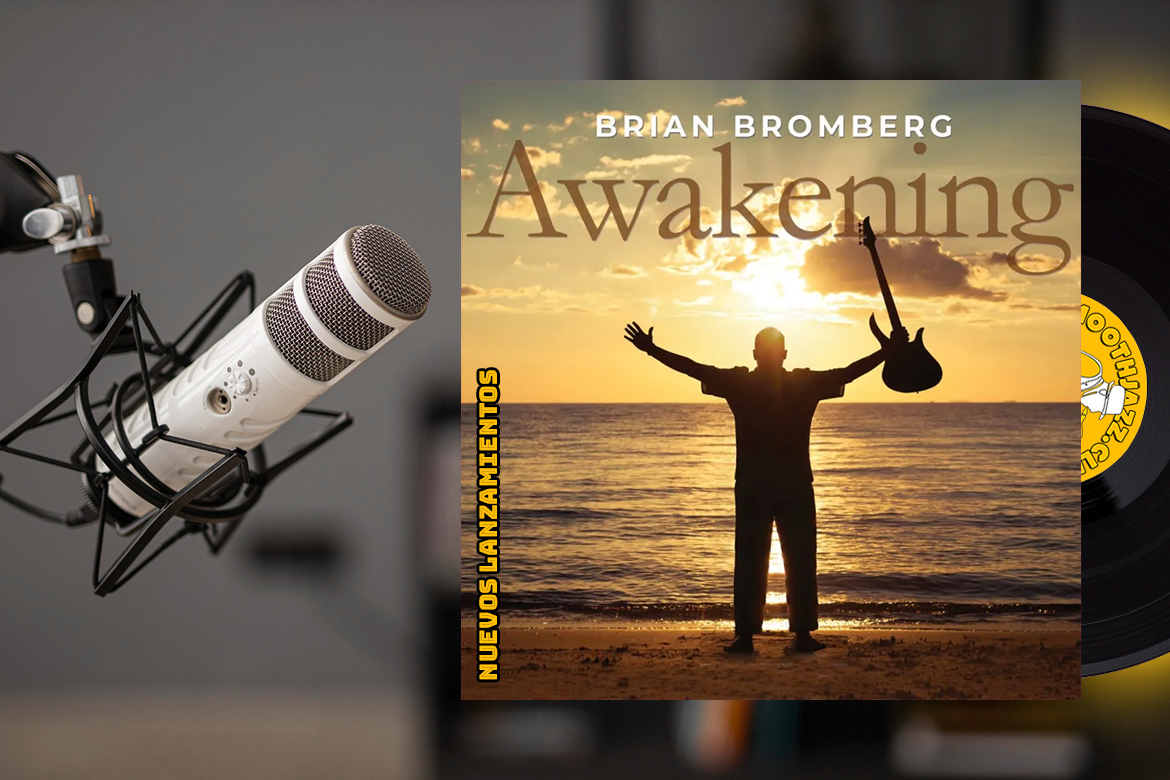
Four decades of bass, innovation and musical storytelling lead to a powerful new chapter
There are bass players who provide the foundation for a song, and there are musicians who completely rethink what the instrument can do.
Brian Bromberg belongs firmly in the second category.
For more than four decades, the Grammy®-nominated bassist, composer and producer has built a career around refusing to be confined by a single definition of jazz. Acoustic jazz, Smooth Jazz, fusion, funk, rock, Latin music and orchestral textures have all found a place in his remarkably broad musical vocabulary.
Now, Bromberg is opening another chapter with Awakening, his upcoming album, scheduled for release on October 9, 2026.
One of the project’s standout moments is “Apparently Not!”, an irresistibly funky collaboration featuring acclaimed saxophonist Everette Harp.
But to understand why a new Brian Bromberg album still feels like an event, it helps to go back to where the story began.
From drums and cello to the bass
Brian Bromberg was born in Tucson, Arizona, on December 5, 1960, into a musical family. His father and brother were drummers, so percussion was his natural starting point. By the age of 13, he was already pursuing music professionally as a drummer.
The bass entered his life almost by accident.
As a youngster, Bromberg had also studied cello, but the instrument did not immediately feel like home. Then, during his school orchestra years, a teacher pointed him toward the large upright bass sitting unused in the room.
That apparently ordinary suggestion changed everything.
Bromberg discovered that the instrument gave him something the drums could not: melody as well as rhythm.
From approximately 14 to 18, he immersed himself in intensive bass practice, while simultaneously playing with as many groups as possible. His teenage years were anything but conventional. He was already taking university-level music classes at the University of Arizona and performing in lab bands, orchestras and jazz combos.
The young musician’s determination was extraordinary.
He has recalled that growing up in Tucson gave him an unusual advantage: there were relatively few bass players around, meaning there were plenty of opportunities to work. He could experiment with different styles while playing multiple gigs during the week.
That intense early apprenticeship would become one of the defining characteristics of his career.
The phone call that changed everything
One of the most important moments in Bromberg’s early life came in 1979.
While touring through Tucson, bassist Marc Johnson, then associated with the Bill Evans tradition, heard the young Bromberg perform. Johnson later mentioned him to legendary saxophonist Stan Getz, who was looking for a bassist.
Bromberg auditioned.
He got the job.
He was just 19 years old.
Joining the Stan Getz quintet gave Bromberg an extraordinary education in real time. Instead of learning jazz history exclusively from records and classrooms, he was suddenly travelling and performing alongside one of the genre’s giants. He spent roughly a year touring internationally with Getz, an experience that accelerated his development enormously.
It was the beginning of a career that would eventually place him alongside some of the biggest names in jazz and popular music.
A bassist who refused to choose just one sound
Bromberg’s subsequent career became defined by versatility.
His credits and collaborations include artists such as Horace Silver, Sting, George Duke, Arturo Sandoval, Boney James, Jeff Lorber, Lee Ritenour, Billy Cobham, Kirk Whalum, Andrea Bocelli, Randy Brecker and Freddie Hubbard, among many others.
He has also worked in the world of film music, contributing bass to soundtracks including The Fabulous Baker Boys, The Preacher’s Wife and The Recruit.
Yet perhaps the best way to understand Bromberg is not through a list of credits, but through his attitude toward the instrument.
He has never treated the bass as merely a supporting voice.
His pioneering work with the piccolo bass, an instrument capable of producing a remarkably high, almost guitar-like register, helped expand conventional ideas about what a bass could sound like.
That same spirit of experimentation has followed him throughout his recording career.
More than 30 albums and a restless imagination
Bromberg has released more than 30 solo albums, moving freely between musical worlds rather than following a predictable formula.
His catalogue includes acoustic projects, Smooth Jazz releases, funk-oriented recordings, fusion, tributes and concept albums.
He has even devoted complete projects to musical heroes and traditions, including Jaco, his tribute to the legendary Jaco Pastorius, Bromberg Plays Hendrix, In the Spirit of Jobim and LaFaro, honoring bassist Scott LaFaro.
This eclecticism is not an accident.
Bromberg has spoken about influences ranging from Buddy Rich and Jimi Hendrix to Stanley Clarke and Jaco Pastorius, as well as the great acoustic bass tradition and composers including Bach, Ravel, Stravinsky and Mahler.
That mixture of influences helps explain why his music can sound simultaneously sophisticated, aggressive, melodic and deeply rhythmic.
Awakening: another chapter begins
That history provides the backdrop for Awakening.
The forthcoming album continues Bromberg’s long-standing habit of bringing together technical mastery and accessible musicality. Rather than treating virtuosity as an end in itself, he uses the instrument to tell stories, establish grooves and create memorable melodic identities.
At the center of the album’s contemporary Smooth Jazz appeal is “Apparently Not!”, featuring saxophonist Everette Harp.
The pairing makes perfect musical sense.
Harp’s expressive saxophone voice provides the melodic counterpoint while Bromberg’s bass anchors the track with the rhythmic authority that has become one of his trademarks.
The result is funk-forward, polished and energetic, but still unmistakably Brian Bromberg.
Why “Apparently Not!” stands out
“Apparently Not!” is the kind of track that immediately reminds listeners why Bromberg has remained relevant across multiple generations of jazz.
The bass is not hiding in the background.
It drives the conversation.
The groove is central, the production is contemporary and the saxophone gives the composition a strong melodic personality. Instead of separating the rhythmic and melodic roles, Bromberg makes the bass part of the lead voice.
That philosophy has been present throughout his career, from his early work as a teenage musician in Tucson to his most ambitious modern recordings.
And it is precisely what makes Awakening feel like more than another entry in an already impressive discography.
The personal side of a musical innovator
Behind the virtuosity is an artist whose career was shaped by persistence as much as talent.
Bromberg’s story began with a teenager who was willing to practice obsessively after being pointed toward an instrument he had not originally chosen.
It continued with a young musician taking virtually every gig available, studying at the University of Arizona and learning on stage.
Then, at 19, came Stan Getz.
From there, the trajectory was no longer simply about becoming a good bass player. It became about discovering how many different musical lives could exist inside one instrument.
That may be the most revealing thread running through Bromberg’s career.
He has never stopped experimenting.
Four decades later, the bass is still speaking
Few musicians can move comfortably between straight-ahead jazz, Smooth Jazz, funk, fusion, rock, Latin music and orchestral writing while retaining a recognizable personal identity.
Brian Bromberg can.
And that is why Awakening arrives with genuine anticipation.
The album is the latest expression of an artist who has spent more than four decades asking the same fundamental question in different ways:
What else can the bass do?
With Everette Harp joining him on “Apparently Not!”, Bromberg once again demonstrates that the answer is probably going to be more interesting than anyone expects.
From a teenage musician in Tucson to an internationally respected Grammy®-nominated artist, Brian Bromberg’s journey is ultimately a story about curiosity.
And after more than 30 albums, countless collaborations and four decades of musical exploration, that curiosity remains very much alive.
Brian Bromberg is not simply playing the bass. He is still expanding its vocabulary.
Awakening arrives October 9, 2026.
Brian Bromberg’s music continues to reach Smooth Jazz audiences worldwide, including listeners across the 75 affiliated radio stations connected with Santiago Fontenla’s SmoothJazz.club network.
