
Some songs belong to a particular moment in music history. Others manage to escape it.
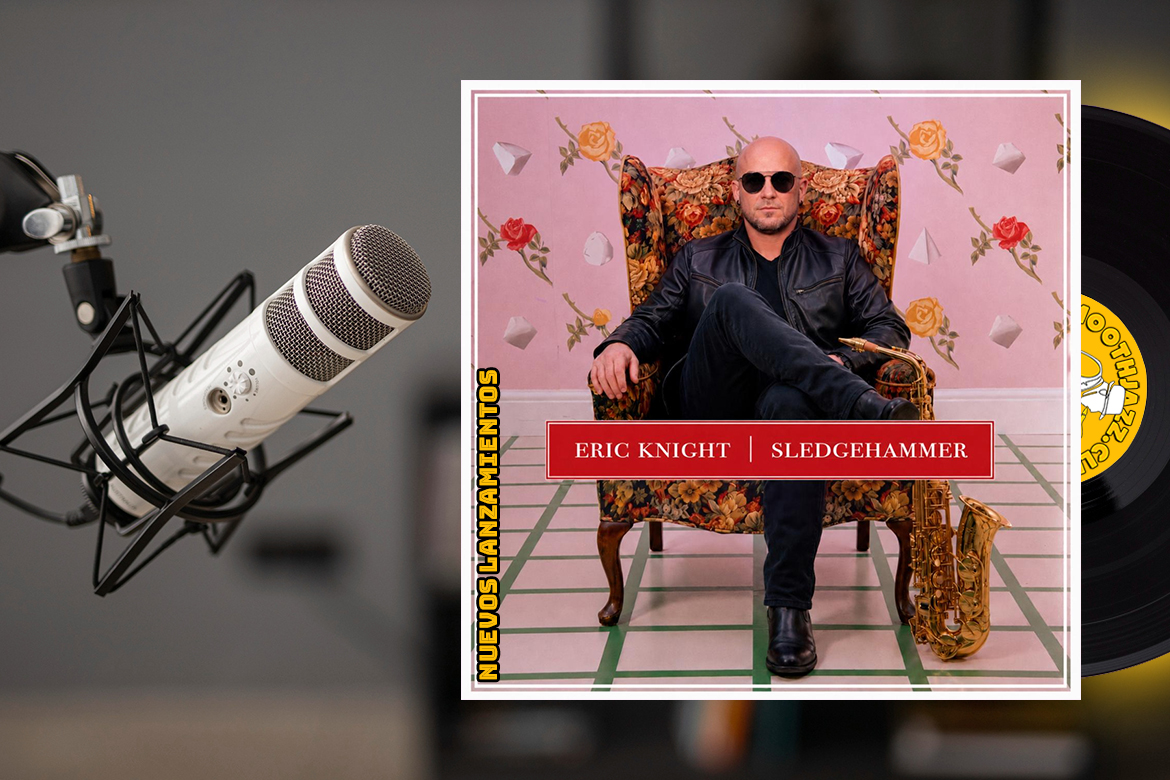
Peter Gabriel’s “Sledgehammer” is firmly in the second category. Four decades after its arrival, its distinctive groove, playful attitude and instantly recognizable melody remain remarkably effective. Now, saxophonist Eric Knight is taking that familiar piece of pop history in a different direction, turning it into an energetic contemporary Smooth Jazz recording.
Released worldwide on August 21, 2026, Knight’s version also represents an important milestone in his career: it is his first release for Woodward Avenue Records. The project brings together a strong group of musicians and producers, including bassist and producer Roberto Vally and GRAMMY-winning producer Paul Brown.
Rather than attempting to reproduce Gabriel’s recording, Knight approaches the song as a musician looking for another way into it. The familiar melody becomes the starting point for a saxophone-led interpretation built around funk, R&B and contemporary jazz.
A song that leaves plenty of room for personality
Knight’s musical background makes the choice particularly interesting.
His career stretches across more than three decades and includes recording, touring and performing with major artists such as The Rolling Stones, Prince, Jennifer Lopez, Etta James and Hiram Bullock. He began studying the saxophone as a child and developed an early fascination with melody and musicianship.
In a previous interview, Knight explained that his father, who played accordion and had studied clarinet, encouraged him to take up the saxophone. His early musical development eventually led him toward the artists who would become major influences on his sound.
Among them were Grover Washington Jr. and David Sanborn, two musicians whose ability to make the saxophone communicate emotionally left a lasting impression on him. Knight has also cited Charlie Parker, Cannonball Adderley, Kirk Whalum and Gerald Albright as important influences.
That background helps explain an important characteristic of his approach: Knight is interested in making the saxophone function almost like a vocalist.
As he put it in his interview, “I see myself as a lead singer, not someone who’s going to showcase their instrumental skills.”
That philosophy is especially relevant to “Sledgehammer.” The original is driven as much by attitude as by melody, and Knight’s challenge is therefore not simply to play the tune on saxophone but to preserve its personality while changing its musical surroundings.
From Peter Gabriel to contemporary Smooth Jazz
The new arrangement draws on several different corners of Knight’s musical vocabulary.
There is the raw funk associated with Maceo Parker, the expressive intensity of David Sanborn and the polished melodic approach associated with Candy Dulfer. Knight combines those influences without turning the recording into an imitation of any of them.
Instead, the saxophone becomes the central voice in a production designed to retain the rhythmic character of Gabriel’s composition while giving it a distinctly contemporary setting.
The musicians surrounding Knight are equally important.
Roberto Vally provides the bass foundation and production, while Paul Brown contributes additional production and mixing. The recording also features drummer Brian Dunne, guitarist Shane Theriot, keyboardist Dave Kochanski, saxophonist and flutist Greg Vail, and trumpeter Ron King.
The combination gives the track a broader instrumental palette than a conventional saxophone cover. Horn arrangements, flute textures, guitar and rhythm section elements work around Knight rather than simply accompanying him.
A career built around communication
There is another reason this recording fits naturally into Knight’s current musical direction.
His previous work has repeatedly explored recognizable melodies through a contemporary instrumental lens. His project Cover 2 Cover – Vol. 1, for example, included reinterpretations of well-known pop and R&B songs, reflecting his interest in bringing familiar material into a modern instrumental environment.
He has also released original material, including “Cash In,” created in collaboration with producer and musician Rodge Nelson. Knight described Nelson as an exceptionally versatile musician and highlighted the creative relationship that developed between them during recording sessions.
That combination of covers and original material has become an important part of Knight’s identity. Rather than treating Smooth Jazz as a formula, he appears more interested in using it as a meeting point between pop, R&B, soul and instrumental jazz.
“Sledgehammer” fits perfectly into that concept.
Forty years later, the groove still works
There is also something appropriately circular about the timing of this release.
Gabriel’s “Sledgehammer” arrived in 1986 and became one of the defining pop recordings of that period. Its groundbreaking visual presentation helped make the song one of the most memorable releases of the MTV era.
Four decades later, Knight is not trying to recreate that moment. He is doing something arguably more interesting: taking one of its musical signatures and asking what it can sound like in today’s Smooth Jazz landscape.
The answer is a recording centered on groove, melody and saxophone personality.
And that may ultimately be the strongest quality of Knight’s “Sledgehammer.” It doesn’t need to compete with the original. Instead, it treats the Gabriel classic as musical raw material and gives it another life.
Another chapter for Eric Knight
For Knight, the release arrives at an important point in his career.
His history with major artists, his experience across pop, R&B and jazz, his Billboard success and his continuing work in contemporary instrumental music have established a foundation that allows him to approach a famous song without being defined by it.
His debut with Woodward Avenue Records adds another significant piece to that story.
With “Sledgehammer,” Eric Knight takes a song almost everyone recognizes and places it inside his own musical world. The result is funky, melodic and unmistakably saxophone-driven—but, most importantly, it sounds like an artist interpreting a classic rather than simply reproducing it.
Forty years after Peter Gabriel introduced “Sledgehammer” to the world, Eric Knight reminds us that a great melody doesn’t necessarily belong to one era.
Sometimes, it just needs a new voice.
